My London Book Fair 2017 #LBF17

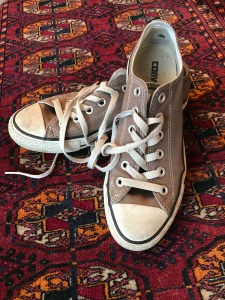
Three days of trudging around Olympia with an increasingly weighty bag of goodies is too long, according to my feet, even when they’re well prepared.

well-worn Converse trainers

But two days, as I found out this year, isn’t nearly enough. While the London Book Fair is industry orientated, there’s plenty for authors to do. Here are some of my highlights.

1 Catching up with friends and colleagues, many of them from ALLi, the Alliance of Independent Authors.

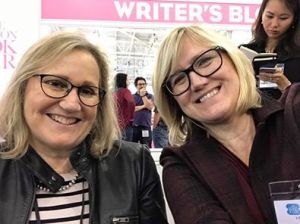
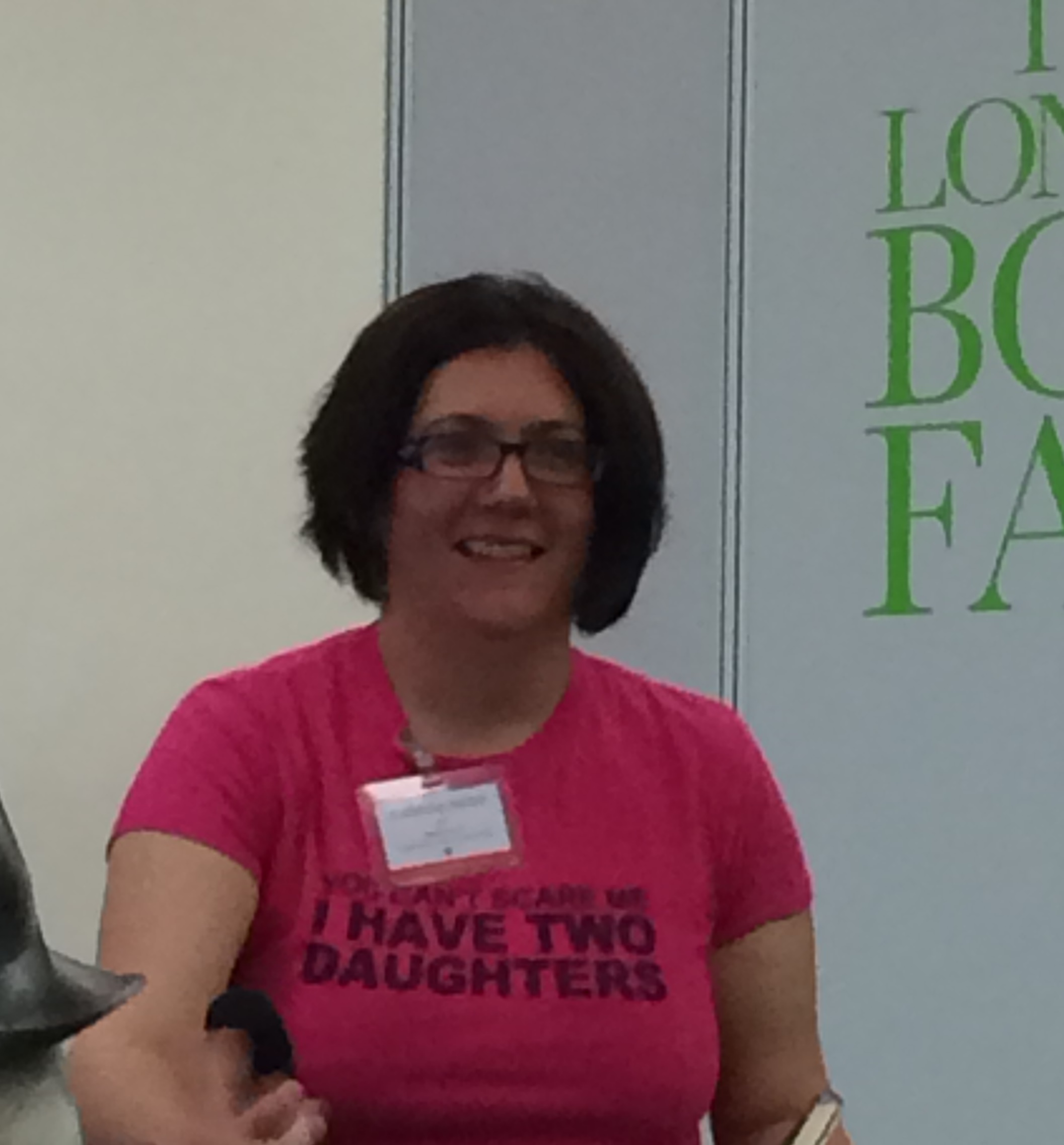
With fellow author Helena Halme

with fellow author Helena Halme


me with cover designer Jessica Bell

with ace cover designer Jessica Bell

Making new friends is part of the fun too. Book people come from far and wide for LBF, like Aussie writer Rebecca Lang from Sydney.

ALLi authors

from L to R: Jessica Bell, me, Rebecca Lang, Glynis Smy

2 Talks at Author HQ.

Author HQ at LBF

The varied fare is excellent, and this year the seats even had proper backs for weary spines. Too bad Author HQ is once again tucked away at the far end of the first floor. You may need GPS and Kendal Mint Cake for the trek.

3 Author of the Day sessions.

They’re at the PEN Literary Salon, which is where I met the inspiring Alaa al Aswany a few years ago. Sadly, this year Roddy Doyle had to cancel his appearance, so, instead of a capacity crowd, there were half-empty benches where people collapsed to eat their sandwiches. As ever, there’s a dire shortage of seating, which is why visitors have to perch on the displays.

following the Yellow Brick Road

4 Learning more about organisations like the Society of Authors, Gardners the wholesalers and distributors, or the Booksellers’ Association. There’s a whole world outside sitting at a desk writing.

the Grand Hall, Olympia

With a bit of planning, you can also arrange one-to-ones with agents or publishers. There are other ways of publishing too. I should have spent longer talking audiobooks.

5 Admiring awesome new books. There are 20 new books published every hour in the UK. Some of them might even be yours.

General Practice Cases at a Glance

at the Wiley stand

6 Haggling over a bagel.

The sticker said £2.75 but it was £4.60 on the price list. In the end, I got it for £2.60. Nothing is quite what you expect at LBF.

salmon bagel

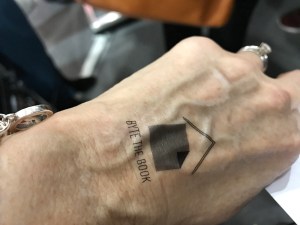
7 The bottle of Veuve Cliquot I won. This was thanks to Byte the Book‘s legendary networking session on the Tuesday evening. I also collected a dozen useful email addresses and a temporary tattoo.

With many friends and colleagues, I only managed snatched conversations between one meeting and the next. Others, like writers from the Romantic Novelists’ Association, I hardly saw. Next year, I tell myself as I get on the train home, it’s back to a three-day marathon.

On the subject of travel, I can’t resist a digression to add that my novel Hampstead Fever will be on special offer in selected WH Smith travel shops throughout the UK from March 30. That’s buy one, get one half price.

Did you go to the London Book Fair? What did you think of it?

Eight Things that Newbie Fiction Writers Get Wrong

I’ve lost count of the number of the people who’ve told me they’re writing a novel. I’ve also met more than my share of successful novelists. Let’s just say that first group of people is a lot larger than the second.

While there are many ways in which a newbie can go wrong, it often boils down to one or more of these common mistakes. old-books1

1 Using stock characters

The tart with a heart of gold. The tall black dude who plays basketball. The gruff schoolmaster. The academic with thick glasses. While stereotypes can occasionally be useful as shorthand, they’re only two-dimensional characters, and that’s not enough to engage readers.

2 Writing real-life dialogue

Yes, you read that right. Realistic dialogue isn’t an echo of real conversation. In everyday life, people use a huge number of filler words and meaningless sounds. Like this.

“Oh, hi, Debbie. Lovely to see you. Yeah, come in, come in. Well, no, I wasn’t really doing anything. Just the ironing, again. It’s OK, no need to take your shoes off. I’m not fussed about the carpet, honest. Right. Now. Um, how about a cup of tea? Or, er, maybe coffee? No, I mean it. I’ve literally just put the kettle on.”

At this rate your reader will be in a coma long before Debbie gets to hear about Mary’s cross-dressing husband.

Realistic dialogue, on the other hand, is a pared-down version of a word-for-word conversation. So it’s more like this.

“Come in, Debbie. Kettle’s just boiled. Look, there’s something I want to talk to you about.”

FreeImages.com/Jay Neill

3 Scenes with overlong description

These usually creep in because the author thinks the writing is so brilliant that it can’t possibly be cut.  Sometimes it’s reams of beautiful description or essential back story. If so, find other ways to get the information across. It’s best to drip details elegantly into your story rather than dump them in bucket-loads onto the reader.

4 Stretching the reader’s credulity

Your college student heroine is a virgin, and has no laptop, or indeed any device connected to the internet? In present-day USA? You’d need your reader to be as gullible as your heroine. There are always exceptions, though, as you’ll know if you read Fifty Shades.

FreeImages.com/spydermurp

5 Using clichés

Maybe your principal character laughs like a drain at her friend’s jokes, goes green with envy at her sister’s new dress, or sweats like a pig at the gym. If so, get rid of hackneyed phrases. Clichés should be avoided like the, er, plague.

6 Ignoring rules of grammar, spelling, or punctuation

Because an editor will fix it all, right? Nope. Your magnum opus may just get binned. Please don’t insult your reader by mixing tenses of verbs, or mistaking it’s for its.

7 Telling instead of showing

His pulse pounded and the words he had rehearsed stuck in his dry mouth gives readers a better feel for your character’s predicament than ‘He was scared stiff about the interview.’

FreeImages.com/Jurga R

8 Shifting points of view

Some books are written from just one character’s perspective, whether it’s in the first person or the third. Others may have two or more. The convention, which I suggest you stick to because it helps the reader no end, is to have just one point of view per scene, or per chapter. Whatever you do, don’t switch a point of view during a scene.

But none of that is a reason to give up if you’ve got a story to tell. The most worthwhile things take effort. Ask a drummer if a drum roll is easy. It is, after the first ten years.

Here’s a selection of books I’ve found useful or inspiring.

Steven King: On WritingThere’s also a blog post from Jon Morrow about it here

Dorothea Brande: Becoming a Writer 

Jessica Bell’s Writing in a Nutshell books, including Writing Workshops to Improve Your CraftShow and Tell in a Nutshell, and Adverbs and Clichés in a Nutshell.

Roz Morris: Nail Your Novel: why writers abandon books and how you can draft, fix, and finish with confidence.

Good advice or not? Please let me know.

Daunt bookshop

Don’t Use a Semi-Colon. Period.

I can’t find it in me to use semi-colons. I know they’re useful, in theory. But since when has effective writing been about theory?

With my thirteenth book about to appear, I can honestly say I have rarely felt the need for that little key just to the right of the L. 

Yes, I see you at the back, waving your arm in the air and bursting to tell me that General Practice Cases at a Glance is full of them. But I didn’t put them there. Or, as the copy-editor would have expressed it, “I know; I did not, however, put them there.” They crept in, aided and abetted by someone who knows more than I do about proper punctuation.

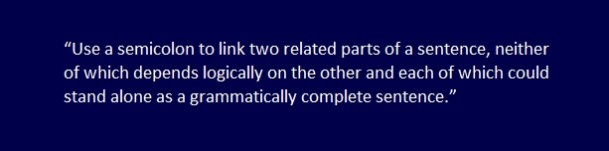
Here’s what the University of Oxford Style Guide says:

Oxford

Each could stand alone as a grammatically complete sentence? Then take off those trainer wheels and let it.

A fellow author and I were discussing punctuation recently.  We’d already exhausted the usual writerly topics such as our word count for the day, and which wine bar was nearest. I think I rashly mentioned semi-colons. Her own editor, like many others, has a fondness for these little squiggles. So, when I admitted to my friend that I try to avoid them at all costs, she asked, “What do you use instead? Colons?”

I nearly dropped my glass of Merlot. I use full stops. Period.

FreeImages.com/Ryan Gageler

I reckon that, over the years, avoiding semi-colons has saved me huge amounts of ink. The claim may be a bit infantile, rather like the school friend who once calculated that bikini briefs saved her several minutes a week, as compared with wearing full knickers. But she made us laugh.

Why use a punctuation mark that can’t decide if it’s a comma or a full stop? It’s a tasteless hybrid. Unlike mules and hybrid vehicles, however, this one breeds. Give a couple of them house room in your manuscript and you’ll soon have them on every page.

Militant semi-colon enthusiasts can get carried away, so I’m reaching for my flak jacket to say I’ve got very few uses for semi-colons. Here’s one.

winking semicolon

Project Semicolon is another.  It’s based on the premise that a semi-colon is used when an author could have ended a sentence but chose not to. As Project Semicolon says, “You are the author and the sentence is your life.”

It’s a global non-profit movement for those who are struggling with mental illness, suicide, addiction and self-injury. You may well have seen semi-colon tattoos, which echo the theme.

There are many moving testimonies on the Project Semicolon blog. Just don’t get too hung up about the grammar.

***

At long last, Hampstead Fever breaks out on Thursday. And the cover’s pretty.

Hampstead Fever MINI FINAL EBOOK COVER MINI

The London Book Fair #LBF16

After three days of the London Book Fair, I’ve unpacked my memories and my bags of freebies. All the usual suspects were there, such as bowls of sweeties on the stands, people in unsuitable footwear, and long queues for overpriced sandwiches.

Olympia is vast, but every corner of every hall was filled.

#LBF16

Can you spot land-locked Switzerland?

Grand Hall, LBF16

Books Are My Bag grows bigger by the year.

Books Are My Bag at LBF16

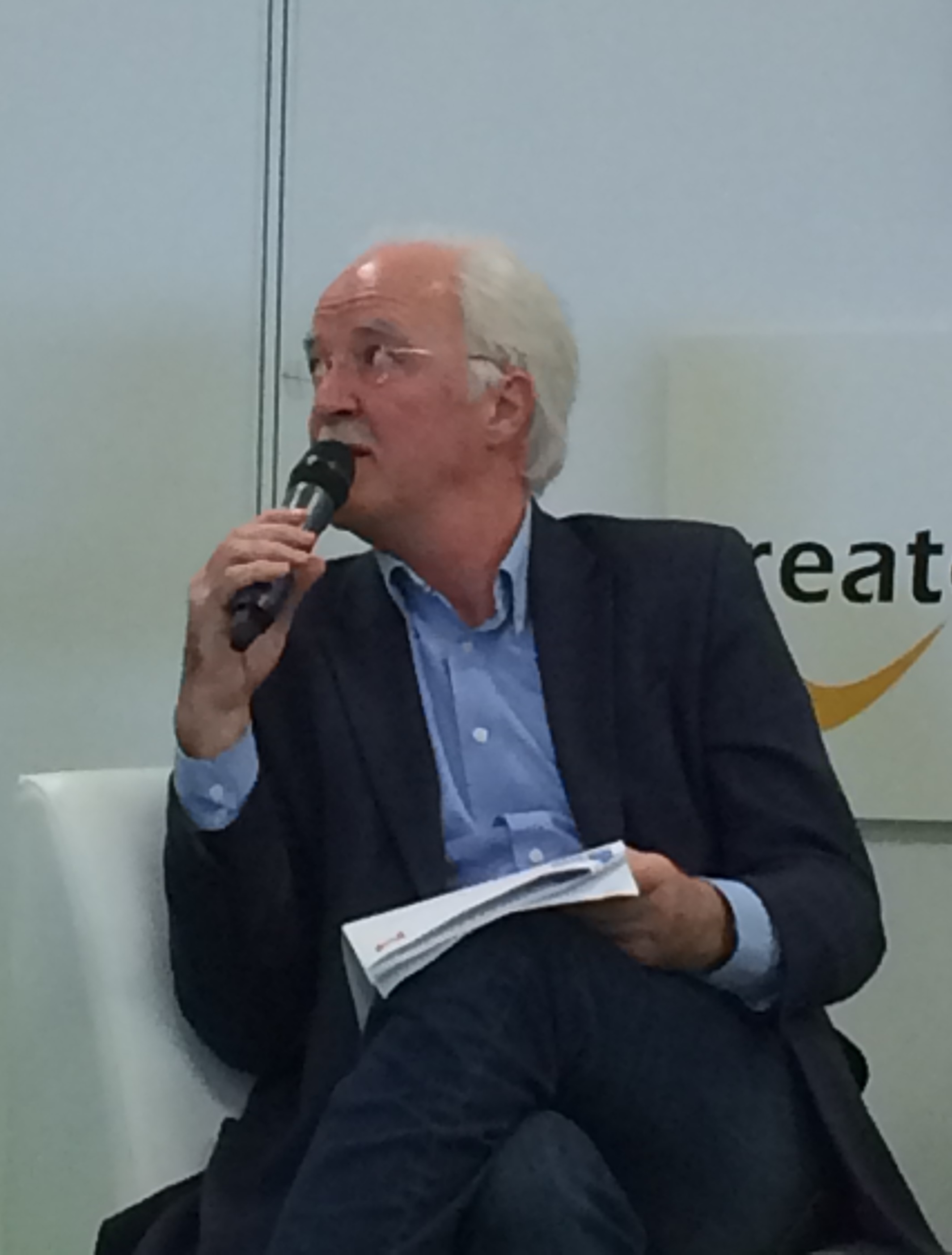
The PEN Literary Salon was a popular destination, especially when the Julian Fellowes entertained with talk of Downton Abbey, his new venture Belgravia, and the eternal truths of writing (eg ‘The trick of life is to be undisappointing’).

Julian Fellowes at PEN, #LBF16

While there’s always an Author of the Day programme, authors are not the main focus of the book fair, even if publishers would find it hard to create many books without them.

Still, there was a goodly contingent of authors, including many independent authors.

Alison Morton, Helena Halme, Jessica Bell, Jane Davis, Peter Snell, Sue Moorcroft, Karen Inglis, Carol Cooper, Roz Morris,

On Tuesday, Alison Morton launched Insurrectio. If you think I missed off an N, you need to get acquainted with her Roma Nova series. 

Alison Morton launching Insurrectio at LBF16

While authors come in all shapes and sizes, there are sometimes uncanny similarities. 

3 literary sisters

Not literally sisters, but literary sisters. In the middle is Helena Halme who writes The Englishman series. Her latest title, The Finnish Girl, is out today. Children’s author Karen Inglis is on the right.

Author HQ may have been relegated to the back of the venue, but it was as packed as ever.

Audience at Author HQ, LBF16

The fair is now over, the final stragglers shepherded out by tannoy at 5pm on Thursday. But today indie authors can attend the Indie Author Fringe here.

And it’s only 11 months to go till #LBF17.

Why should I go to the London Book Fair?

As I look forward to next week’s London Book Fair, I realize I haven’t got a notebook, my comfy shoes need re-heeling, and I’ve been so busy editing that I haven’t properly checked out what’s on, let alone printed my badge. So I think fellow author Sue Moorcroft’s advice is very timely. Here it is, fresh from her blog with my thanks.

A Self-Publishing Pioneer in the Family

Authors who began self-publishing in 2010 are often called ‘early adopters‘, but one Jacqueline Cooper was at it way back in 1994, when many of today’s indie authors were still at primary school. I make no apology for blogging again about my mother, because, at 5’1” and in her seventies, she was a feisty self-publishing pioneer.

Here’s her story, adapted from the Courier magazine, September 2000.

It’s simple. All you need is a little money you can afford to lose if your book doesn’t sell, and a lot of energy to do the marketing.

When I lived in the USA, well-known publishers produced two of my books. They took 18 months to appear in bookstores, and, although there were royalties and excellent reviews, they did not make me a fortune.

Angus and the Mona Lisa

I moved to Geneva in 1990 as a retraitée (retired person), only sending the occasional story to a magazine or to the BBC. But in 1994 my old school, the English Girls’ College in Alexandria, was having its first ever reunion of Old Girls in London. What with revolutions, wars, marriages, births, we had lost touch and were scattered across the globe. One Old Girl had found us all, even the Japanese sisters we thought had perished at Hiroshima.

Here was a ready market, filled with nostalgia.

I still had vivid memories not included in my first book Cocktails and Camels. I was galvanized into action. Cocktails & Camels, by Jacqueline Cooper
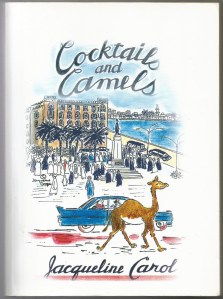
I approached a printer who had done work for the American International Women’s Club of Geneva (AIWC), and asked for an estimate. If I wanted 1,000 copies with a few black and white illustrations, how much would it cost? I bargained. I was sure this book, Tales from Alexandria, would sell. And I would have no commission to pay.

I kept track of what was going on. ‘Just passing by,’ I’d say, even though the printer was on the other side of town. I’m glad I did. Margins were uneven, illustrations either too dark, too light, or lopsided, and, when the books were finally delivered, page 66 was blank and the quotation at the top of Chapter Four was missing. I howled. The books were reprinted, the cost reduced, and the edition sold hand over fist. Tales from Alexandria by Jacqueline Cooper
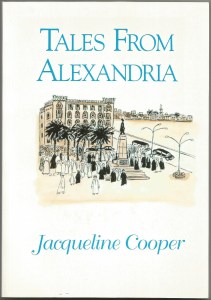
At first I hadn’t planned to deal with bookstores. But why not sell Tales from Alexandria at Harrods? So I did. I then contacted two Geneva bookstores, Payot and ELM. Commission was high at 35-40%, except for ELM, our friendly bookstore.

In 1997, unable to find anything for children on Geneva’s famous Escalade of 1602, I decided to do my own book. I knew about children’s picture books, as I’d worked with the art director in New York on my Angus and the Mona Lisa. This time I went to the printer who produce the AIWC’s Courier magazine. He had no idea about picture books, but was keen to learn.

Toby and the Escalade by Jacqueline Cooper

Toby and the Escalade is a bilingual English-French book with pictures on every page. It was expensive to produce. Although I knew what a page should look like, I had little idea of page layout, so I asked a friend to help. The book sold well. We went into a second edition that still sold well many years later.

You have to wait to make a profit from self-publishing.

At first, I loved marketing. I contacted the managers of a dozen Geneva bookshops in person, and out-of-town retailers by phone and with cards I’d made of the book cover. I offered them a copy of my book. I spoke to pupils at the International School, and was interviewed on a couple of radio stations.

I made posters which I sent to bookstores along with their order.

When I walked into Payot one day, there was my Toby and the Escalade poster hanging at the top of the stairs with the phrase ‘Vient de paraître!(Just in!)

I made only two press contacts, but newspapers contacted me because the book was selling, as the Tribune de Genève put it, ‘comme des petits pains’ (hot cakes to you and me). Then Naville bookstores called me from Lausanne, asking me urgently for copies.

Two department stores, Globus and Placette, refused to stock Toby and the Escalade. Globus only took books through distributors. But Placette changed their mind two years later when the buyer changed.

The same printer produced my next two books, Cat Day and William Tell. All three books were bilingual, which probably helped sales.

William Tell by Jacqueline Cooper

But even with my good printer there were problems with the illustrations for William Tell. The pictures were anaemic and bore little resemblance to the originals.

In the end, though, it all worked out, by which time I was a nervous wreck.

When I injured my back and could no longer run all over town with books, I contacted a big distributor used by Globus. He liked Toby and the Escalade and wanted to sell it for CHF 25 instead of CHF 20. He would take 50% of sales. I agreed to a contract. But when I read it carefully, I did not like the clause that said he would distribute every book I would ever write. When I asked if that clause could be removed, he angrily broke off the contract.

Marketing is a lot of work, and so is distributing: keeping track of orders, enclosing an invoice with each consignment, packaging and mailing heavy parcels.

The post office can come and collect them, but it is very expensive. There are bills to make out, phone calls to reluctant payers, and dealing with orders that keep coming in. I got small orders for one, two, or three books, and I had to make another invoice, another parcel, another trip to the post office – and then keep an eye on everything. For me the novelty has worn off. A bookstore in Nyon has owed me the princely sum of CHF39 for over six months. The other day, Payot faxed me at 7.30am for one copy of Cat Day.

Self-publishing has been fun, and it worked for me at first. But now I’m sick of it and don’t plan to do another book.

Though, come to think of it, a brilliant idea just popped into my head…

Le Crazy Cat Saloon

Keep it Short, Stupid

War and Peace, when it was a 1,225-page blockbuster rather than a toothsome TV adaptation, was a by-word for long and weighty.

FreeImages.com/Davide Farabegoli

At medical school, one lecturer seemed bent on following in Tolstoy’s footsteps. Using ten words when one would do, he habitually overran, but did he cram more in? Was his specialism more vital than others? No.

Sadly, many speakers drone on at length, oblivious of their audience and of those scheduled after them, their numerous PowerPoint slides an accessory to their crime of disrespect.

alarm clock

Most topics, even Brexit, could be covered more succinctly. Going too long is blatant laziness. “I didn’t have time to write a short letter, so I wrote a long one instead,” said Mark Twain. Others, including Cicero, TS Eliot, and Blaise Pascal have expressed the same sentiment.

As the cliché goes, it would be easy for journalists from The Sun newspaper to write for The Times, but not vice versa. Guido Fawkes, who has done both, agrees. 

fabric tape measure

Keeping it short leaves little scope for nuance. On the plus side, readers won’t give up in droves, as if their team is losing 6-0.

KISS. Less is [word count exceeded]

***

You may like to read: 10 Tabloid Tips to Better Writing, from Writer’s Digest and my writing colleague Dan Holloway on Why Less is More When Reading or Performing Your Work in Public.


What to Put in Your Writing Space (and What to Leave Out)

As one of the least tidy people, I’m not remotely qualified to tell you, but my wonderful writer friend Joni Rodgers knows exactly what a workspace needs and doesn’t need. It’s taken from a post she wrote called The Art of Upscale Downsizing, this is what she did. I hope it entertains and inspires you. 

Joni Rodgers, author

Earlier this month, the Griz and I moved into our new quasi-retirement digs (read Ageing Hippie Lakeside Love Grotto), between thunderstorms and flash flood warnings. As water continued to rise just a few hundred yards from our new place, the complex management sent out text messages warning residents to watch for snakes on the property, and in the spirit of encroaching apocalypse, I did something I’ve never done before: I made my office my first priority.

Typically, my office (or my cough “office” cough) has been the last room in the house to be finished. This time, my kids are grown, my life is my own, and the Griz is happy to share center stage with the work that keeps me happy and contributing to our solvency. I’m scheduled to dive into editing Orna Ross’s forthcoming historical novel about W.B. Yeats and his paramour Maud Gonne. It’s a beautiful, important book, and I wanted to be ready for it.

My new sun-room office in this one-bedroom apartment is just 8×10 feet–half the size of my upstairs office, with which I’d fought a major organizational/ housekeeping battle, in our old four-bedroom house. I was nervous about the drastic downsizing, but as I worked through the process, I made three simple rules, which turned out to be the three things I love most about my Woolfish “room of one’s own”:

1) Every object must earn its footprint. For me, that means everything in this room has to a) serve and purpose and b) make me happy. Utilitarian + Joy = worth it.

Making the cut: A Salvador Dali coffee table book doubles as a lap desk. A Dr. Seuss lunch-box that houses paperclips and pushpins. My great-grandma’s kitschy plaster cat, now in charge of pens and highlighters.

No longer happening: Furniture, wall art and tchotchkes that were nice to have and sometimes hard to let go of but didn’t pass a test of archival value (“Will my kids really want this after I’m dead?”) or serve a daily need.

Gorgeous thrift store china cabinet: no. Tiger oak chair rescued from a defunct VA hospital: yes. I could have made an argument for the usefulness of either one, but the chair earns that footprint. The cabinet served as a junk collector simply because it was there. No cabinet = no junk. Winning!

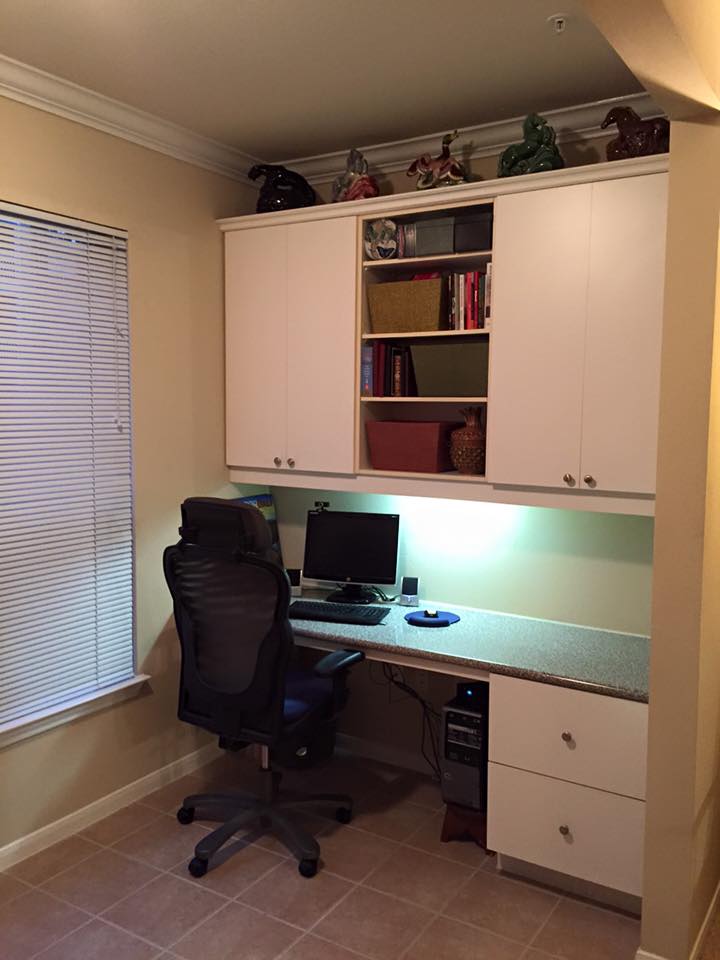
Joni's new workspace

2) Nothing but work happens in the workspace. It occurred to me that my most precious natural resources, time and space, are both limited, and my mindset for one naturally influences my mindset for the other. This small square footage is premium real estate, and it’s most valuable to me as clean, feng shui friendly floorspace. Cluttering it with plastic bins, file boxes and obsolete computer equipment detracts from the calm, creative vibe I’m striving for, and though a lot of that stuff is arguably work-related, it’s not the work I’m working on now, so it doesn’t earn a footprint in this space. 

Same goes for time clutter. A while back, I declared a “Facebook only while standing” policy, which immediately made me more mindful of the time I was wasting there. I try to justify social network activity as “platforming”, but in truth, 90% of that falls more accurately under “farting around”. So no more magazines or leisure books on the desk, and no more games or aimless net surfing on the office computer. (Isn’t that why God created smart phones?)

Old manuscripts, tax records, press archives, correspondence and keepsakes took up a huge amount of space in my old office and our over-spill storage unit. I invested in a NeatDesk scanner and opted into their whole system. I’m still working through the mass exodus of paper from the storage unit, but the bottom line is: everything that can be digital must be digital. And almost anything can be digital.

I’ll admit, I cried letting go of my kids’ school projects, which I’d been justifying as decor in my old office. I’m keeping a few framed pieces for the wall here, but everything else is being digitally archived. My plan is to compile a coffee table book for each kid, which will be equally feng shui friendly in their future homes.

3) I work at home; I do not live at work. In the past, when my office got out of control, I could close the door and keep the insanity to myself. My new sun-room office is open to the living room in our new apartment, so it has to jibe with the living room aesthetic, and that forced me to be more mindful of the way my work serves (or or doesn’t serve) the greater goal: a happy, healthy home life with this man I love. My work tends to take over at times, and I’ve learned that allowing work to hog all my time, space and waking thought actually makes me less productive in the long run, because I get fried and don’t allow myself to recharge.

While plotting books, I’ve always built out massive grids of sticky notes on the wall à la Beautiful Mind. I had stacks of books that were sent to me for reviews and blurbs. I tacked up Max Parish and Ansel Adams calendar art and scrawled notes on corkboards. The purpose of all that (in my head) was part organization, part inspiration, and it worked for me in that space, but it’s not what I want to look at when I’m sitting in my living room. Not working. (No, really, I’m not. Seriously! I really mean it this time!)

Going forward, I’ll be organizing writing and ghostwriting projects with Scrivener, which allows me to integrate research, character notes, and chapter material. (Try it! You’ll like it.) A Passion Planner satisfies my need to physically write things down and brilliantly brings all those random corkboards and creative impulses into an intelligent plan of daily, weekly and monthly actions that pragmatically serve my creative goals. Instead of keeping a file drawer for editing and ghostwriting clients, I’m streamlining editing and book doctor projects via a nifty online system called 17 Hats, which allows me to create typical work flows from first contact to client invoice.

Joni's snazzy wall art

So instead of a blizzard of flailing sticky notes, I now have one powerful, wall-wide work of art that genuinely does serve to inspire me and provides a super cool counterpoint to the more conventional living room art. I got this amazing canvas frame X-Men panel on Overstock.com for less than $100. (It’s actually a room divider.) It comes from “The Dark Phoenix Saga”, in which Jane Grey (now Phoenix) kicks the stone-cold keister of Emma Frost (aka the White Queen).

Her power is a song within her… a passion beyond human comprehension. She is more alive than she has ever been

Just the right vibe for a fiercely focused and beautifully functional creative workspace.

Crazy for Trying

You can find out more about Joni’s writing and other talents right here on her website.


Inside the Dragons’ Den

What happens when aspiring authors have to brave not one but four literary dragons in front of a live audience? 

The London Book Fair (LBF2015 to the cognoscenti) had a demob flavour on its final session of the afternoon, but not in Author HQ where for ten hopefuls the serious stuff was just cranking up.

Seen Dragon’s Den? That’s how The Write Stuff was organized. Ready to breathe fire on the ambitious writers were agents Mark Lucas, Toby Mundy and Lorella Belli, plus non-fiction publisher Alison Jones.

They didn’t look that fierce from where I was sitting. As we waited for the start, I couldn’t tell if Belli and Jones were discussing books, designer shoes, or their team’s chances for the next season, but it all seemed quite jolly.

Alison Jones, left, with Lorella Belli

Alison Jones, left, with Lorella Belli

Then the real business began, with the contestants standing in front of the panel plus a packed Author HQ to sell themselves. Each had just one minute to say who they were, two minutes to pitch their book, and five minutes for questions and comments from the panel, who had already sampled their opening chapters.

This happened a few weeks ago now, but there were lessons that authors should remember for all time.

First up was Lucy Brydon, a young Scottish film-maker who presented a novel set in China where she had worked. While The Boy Who Died Comfortably was redolent of Chinese culture and highly filmic. Toby Mundy wasn’t so sure that, as a foreigner, the author had ‘a place to stand in this story.’

Toby Mundy

Agent Toby Mundy

Characters came under scrutiny when romance writer Catherine Miller pitched her novel Baby Number Two.  The panel was clearly impressed with her perfect title, as well as her blurb, her writing, and her Katie Fforde bursary. AND she’s a mother of twins.

Catherine Miller

Catherine Miller

They weren’t so keen on her characters’ motives, however. Alison Jones also felt she had shoehorned in too many topical subjects.

Caroline James also writes mainly for women. Coffee, Tea, the Caribbean and Me was aimed more at those in their fifties, and drew on her experience in the hospitality industry. ‘Highly relatable,’ thought Mark Lucas, relatable being the buzzword de nos jours.

agent Mark Lucas

Agent Mark Lucas

The authors received all the comments with good grace, though Olga Levancuka was a tad more combative.  There she stood in her full-length orange coat, looking every inch the Skinny Rich Coach (her alias). She responded feistily when the panel questioned her approach and her credentials.

Olga Levancuka, aka Skinny Rich Coach

Olga Levancuka aka Skinny Rich Coach

Mike Rothery had spent decades in the Navy, so no surprise his novel The Waiting-Pool involves an ocean voyage. And a jaunty hat.

Mike Rothery

Mike Rothery

It was a good thriller, thought the panel, but it took a bit too long to get started, and Alison Jones couldn’t bring herself to care that much about the characters. The protagonists had started life in another of Mike’s books, so getting the amount of back-story right may have been an issue. A tip here for anyone writing a series, I think.

Vittorio Vandelli

Vittorio Vandelli

Italian satirist Vittorio Vandelli presented a tub-thumping account of the dystopia of the Berlusconi period. What had happened in Italy was, he claimed, a dire warning to Western democracy everywhere. He soon digressed from his blurb and just gave us his tirade.  As entertaining as it all was, Vittorio and his book came on a little strong. Mark Lucas said he felt he was being smacked over the head with all the things he should be outraged about.

Caroline Mawer is a doctor, globe-trotter, photographer, and author of A Single Girl’s Guide to Modern Iran. The panel thought there wasn’t enough of herself in the work, and the title wasn’t faithful enough to the text.  Wouldn’t Skinny-Dipping in the Spring of Solomon have been more arresting? Maybe literally?

Caroline Mawer

Caroline Mawer

Up stepped Julia Suzuki. Her children’s book The Crystal Genie is, appropriately enough, all about dragons. The panel sat bolt upright. Was it about them? They all claimed to adore dragons. But it is no longer enough, apparently, for dragons to be green. Even the youngest readers must now have them in shades of grey. Alas, Suzuki’s characters were ‘a bit too black and white.’   

Julia Suzuki

Julia Suzuki

Lennox Morrison, an award-winning journalist from Aberdeen, offered a collection of short stories. Although she writes ‘like a dream,’ the consensus was that short stories are very difficult to sell on a grand scale.

The winner was another journalist, Sanjiv Rana, who pitched The Insignificance of Good Intentions. This first person novel is about a 33-year old virgin who’s sent to prison charged with rape. Sexual assault is a big problem in India, though, as the panel said, false accusations of rape aren’t usually the issue, so it’s an original angle. The panel agreed that Rana has a very original voice too. You think that stopped them comparing him to other writers? Think again. 

Sanjiv Rana receives his award

Sanjiv Rana and certificate

Rana won an appointment with Toby Mundy, and a framed certificate for slaying dragons. 

What did the other writers get out of it?  Olga landed herself an agent shortly afterwards, and Caroline Mawer did change the title of her book. Her thought-provoking take on The Write Stuff is well worth a read. It’s on Words With Jam right after my piece.

Meanwhile Catherine has completed her novel, and I for one am dying to read it.


Selfish Thoughts on World Book Night

No, I’m not doing anything for it either. Not giving out any of the 20 lovely books, or encouraging people to love reading. Nor (and thank you for reminding me it’s also St George’s Day and the anniversary of Shakespeare’s death) even reciting random sonnets while dressed up as a dragon. Though it might have been fun.

St George

I’ll be doing something far more self-centred. Writing two more books, and hoping that at least one of them will be done by the deadline without my turning into a dodgy fabric merchant. The worst thing about writing is that you become a recluse, as my family often points out. My husband is hovering as I write, holding up that dragon costume that will remain unworn this year, just as last. I may look up momentarily and point out that St George, if he slayed the dragon at all, slayed him in Lebanon, not England, before returning to my work in progress.

The second worst thing about being a writer is that you run out of time for reading. But all authors love reading. It’s what made them write in the first place.

Kathleen Jones

So I’m pointing you in the direction of a celebration of reading by the authors of Outside the Box: Women Writing Women, with Jane Davis, Joni Rodgers, Orna Ross, Kathleen Jones, Roz Morris, Jessica Bell and myself, along with a guest spot from bookworm extraordinaire Peter Snell. It’s all right here on Jane Davis’s fine blog.

Happy reading.

Carol Cooper